What is Multimedia?
Multimedia, In common usage, refers to an electronically delivered combination of media including video, still images, audio, text in such a way that can be accessed interactively. Much of the content on the web today falls within this definition as understood by millions. Some computers which were marketed in the 1990s were called "multimedia" computers because they incorporated a CD-ROM drive, which allowed for the delivery of several hundred megabytes of video, picture, and audio data. That era saw also a boost in the production of educational multimedia application CD-ROMs.
History of the term Multimedia
The term multimedia was coined by singer and artist Bob Goldstein to promote the July 1966 opening of his "LightWorks at L'Oursin" show at Southampton, Long Island. Goldstein was perhaps aware of a British artist named Dick Higgins, who had two years previously discussed a new approach to art-making he called "intermedia".
On August 10, 1966, Richard Albarino of Variety borrowed the terminology, reporting: “Brainchild of songscribe-comic Bob (‘Washington Square’) Goldstein, the ‘Lightworks’ is the latest multi-media music-cum-visuals to debut as discothèque fare. Two years later, in 1968, the term "multimedia" was re-appropriated to describe the work of a political consultant, David Sawyer, the husband of Iris Sawyer—one of Goldstein’s producers at L’Oursin.
In the intervening forty years, the word has taken on
different meanings. In the late 1970s, the term referred to presentations
consisting of multi-projector slide shows timed to an audio
track. However, by the 1990s 'multimedia' took on its current meaning.
In the 1993 first edition of McGraw-Hill’s Multimedia:
Making It Work, Tay Vaughan declared “Multimedia is any combination of
text, graphic art, sound, animation, and video that is delivered by computer.
When you allow the user – the viewer of the project – to control what and when
these elements are delivered, it is interactive multimedia. When
you provide a structure of linked elements through which the user can navigate,
interactive multimedia becomes hypermedia.
The German language society, Gesellschaft für
deutsche Sprache, decided to recognize the word's significance and
ubiquitousness in the 1990s by awarding it the title of 'Word of the Year' in
1995. The institute summed up its rationale by stating "[Multimedia] has
become a central word in the wonderful new media world.
History of Multimedia
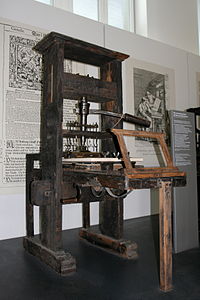
Printing Press
The printing press was invented in the Holy Roman Empire by the
German Johannes Gutenberg around 1440, based on existing screw presses.
Gutenberg, a goldsmith by profession, developed a complete printing system,
which perfected the printing process through all of its stages by adapting
existing technologies to the printing purposes, as well as making ground breaking
inventions of his own.

Gazettes Newspapers
The newspaper in its modern form is usually regarded as beginning
in 1566, when the government of Venice, Italy, issued written news-sheets and
exhibited them in the streets. Anyone was allowed to read them on payment of a small
coin called Gazetta. Onthis account the news-sheets were called gazettes.
In 1822, Charles Babbage proposed the use of such a machine
in a paper to the Royal Astronomical Society on 14 June entitled" Note on
the application of machinery to the computation of astronomical and mathematical
tables". This machine used the decimal number system and was powered by
cranking a handle.

Analytical Engine
The Analytical Engine was a proposed mechanical
general-purpose computer designed by English mathematician Charles Babbage. It
was first described in 1837 as the successor to Babbages Difference Engine, a
design for a mechanical computer.

In 1879, Thomas Edison granted the patent of phonographs.

Adding Machine
In 1886, Burroughs First commercially successful adding
machine.
The first primitive radio transmitters (called Hertzian
oscillators) were built by German physicist Heinrich Hertz in 1887 during his
pioneering investigations of radio waves. These generated radio waves by a high
voltage spark between two conductors.
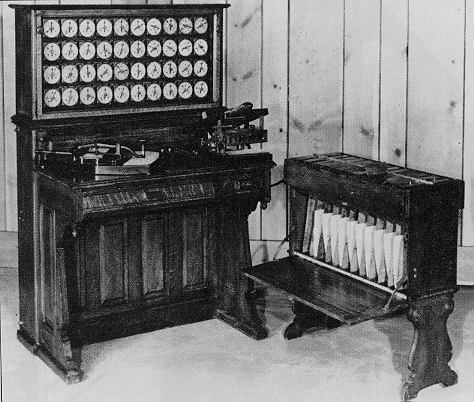
Tabulating Machine
The tabulating machine was an electrical device designed to
assist in summarizing information and, later, accounting. Invented by Herman
Hollerith, the machine was developed to help process data for the 1890 U.S.
Census. It spawned a larger class of devices known as unit record equipment and
the data processing industry.

Nickel-in-the-slot phonograph
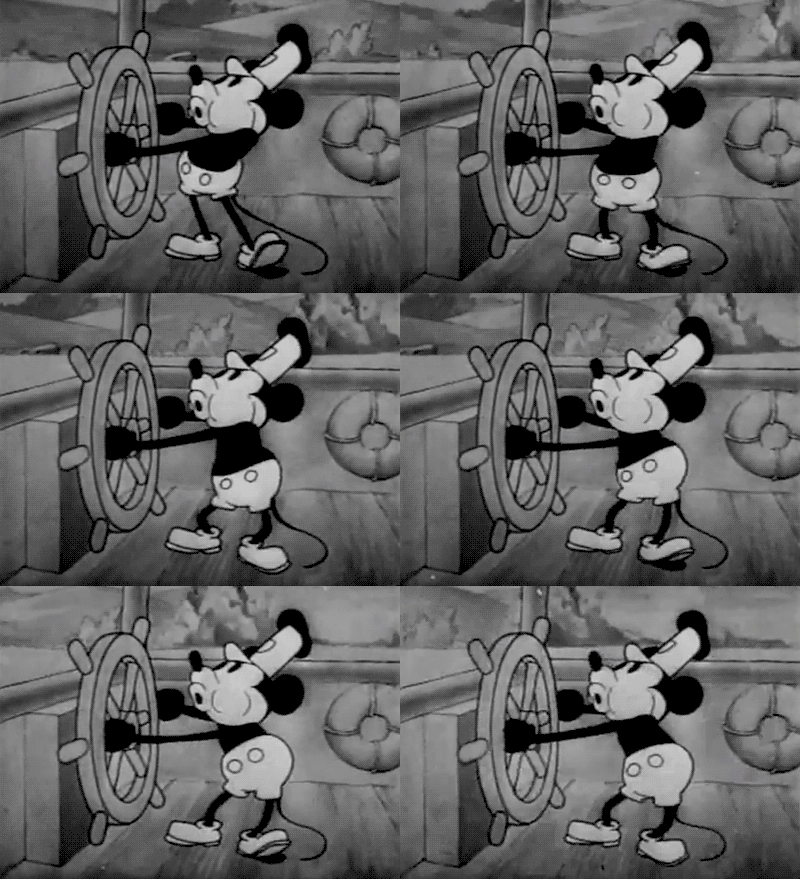
Mickey in the Steamboat Willie
Steamboat Willie is a 1928 American animated short film
directed by Walt Disney and Ub Iwerks. It was produced in black-and-white by
The Walt Disney Studio and released by Celebrity Productions. The cartoon
is considered the debut of Mickey Mouse, and his girlfriend Minnie.

Magnetic Tape
Magnetic tape was invented for recording sound by Fritz
Pfleumer in 1928 in Germany, based on the invention ofmagnetic wire recording
by Valdemar Poulsen in 1928. Pfleumers invention used a ferric oxide (Fe2O3) powder
coating on a long strip of paper. This invention was further developed by the
German electronics company AEG, which manufactured the recording machines and
BASF.

Atanasoff-Berry Competer
The Atanasoff–Berry Computer (ABC) was the first electronic
digital computing device. Conceived in1937, the machine was not programmable, being
designed only to solve systems of linear equations.

Zuse - Z3
1943:Zuse – Z3: First machine to work on a binary system
rather than decimal system.

The first transistor
1948: Shockley, Bardeen and Brattain develop the transistor.
More reliable and cheaper to run the vacuum tube.

IBM 701
IBM 701: First electronic stored computer that use vacuum
tubes, Ram, punch cards and was the size of a piano, was announced to the
public on April 29, 1952

Atari 1972
In 1972 the first commercial video game was released by The
Atari inc.
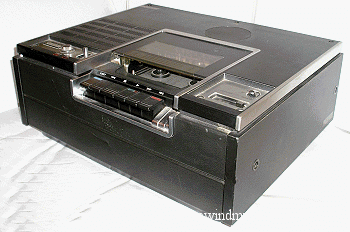
SONY Betamax VCR
SONY Betamax VCR with a one hour, ½ inch video cassette
tape.1975.
Future of Multimedia
1) Graphic imaging technology
There is a concept of future technology - Graphic imaging technology. With it users can effortlessly and instantly inquire everyday info such as calendar, stock market, maps, ID card, weather report and so on. It also allows high definition video playback to make your video chat and long-range cooperation better with dynamic adjustment of the screen size. Amassing a vast collection of songs, users can enjoy high-fidelity sound quality on the go. Providing a flexible user interface, the portable device ensures an immersive game experience so the avid gamers could have an unprecedented game life.


3) Multimedia is shifting from being
localized (contained on a CD-ROM) to being distributed (available on the World
Wide Web). What are some of the implications of this? Who will have access to
the presentation? How will you keep it secure? How will you distribute it?
What are some of the implications of this?
It implicates that users are able to access the multimedia from different locations and reduce the distribution of multimedia cost. It allows people to move easily from one Web page to related information elsewhere on the same page, on the same site or one a different site half-way around the world. Besides that, it allows people to Localize and scope of media mentioned above concerned geographical aspects. This is also true for thematic aspects. There are today millions of communities specialized on specific themes (languages, hobby, nature,…). While there are thematic radio, newspaper, TV, and magazines, their diffusion is geographically limited, while these communities are spread over the Web. The Web, by connecting people, enables those with shared interests to exchange their resources independently of their respective locations.
Who will have access to the presentation?
Only the authorized and related users have the right to access to the presentation.
How will you keep it secure?
When keeping files in internet, always use a difficult to guess password on all websites. Avoid using a single combination of username/password for all websites. Secondly, use encryption software to protect sensitive data. Keep all your sensitive data in one main folder and use a software like TrueCrypt to create an encrypted volume. With encrypted volume to store all your sensitive data, even if you lose your laptop, your data will be safe. Thirdly, Use the HTTPS versions of sites. This simple fix will help you keep the data you send back and forward between your computer and websites like social networks private.
How will you distribute it?
I will distribute the files through email, I will make sure that I send to the correct persons. Besides that, password is required to open the files. Also, I will upload the files to a online storage and put a strong password to protect it.
1) Graphic imaging technology
There is a concept of future technology - Graphic imaging technology. With it users can effortlessly and instantly inquire everyday info such as calendar, stock market, maps, ID card, weather report and so on. It also allows high definition video playback to make your video chat and long-range cooperation better with dynamic adjustment of the screen size. Amassing a vast collection of songs, users can enjoy high-fidelity sound quality on the go. Providing a flexible user interface, the portable device ensures an immersive game experience so the avid gamers could have an unprecedented game life.
2) Virtual reality - It uses multimedia content. Applications and delivery platforms of multimedia are virtually limitless.
3) Flexy Multimedia Device
How might it influence uses in negative ways
Nowadays, children use a variety of multimedia learning programs, which either seek to teach or reinforce basic skills in math, language, reading, and other subjects. Other software allows children to draw pictures or create visual works of art and self-expression. Communication with others is growing as an application of computers by children, particularly as more homes and schools gain access to the Internet. As computers continue to become more powerful, increasing numbers of children are using computers to create multimedia presentations and even web sites that include pictures, text, audio, and even video.
In addition, for e-learning, the learners self-guide through the training. This is
problematic for those not used to being a self-directed learner, are uncomfortable by the lack of
an instructor or are not comfortable relying on objectives. These variations on learner’s
preferences may result in a hesitancy and reluctance to learn. Those whose learning style
requires more structure and guidance may become frustrated. Some less-experienced or less
well-disciplined learners may also make poor decisions about how much information they need,
resulting in information overload.
Shortcomings of multimedia
There are several shortcomings which are:
1) Information overloads. Because it is so easy to use, it can contain too much information at once.
2) It takes time to compile. Even though it is flexible, it takes time to put the original draft together.
3) It can be expensive to develop. Multimedia makes use of a wide range of resources, which can cost large amount of money.
4) Too much makes it unpractical. Large files like video and audio has an effect of the time it takes for the presentation to load. Adding too much can mean that you have to use larger computer to store the files.
5) In case you want to upload it onto the internet, there are a few factors to consider, for example, network bandwidth.
What are some of the implications of this?
It implicates that users are able to access the multimedia from different locations and reduce the distribution of multimedia cost. It allows people to move easily from one Web page to related information elsewhere on the same page, on the same site or one a different site half-way around the world. Besides that, it allows people to Localize and scope of media mentioned above concerned geographical aspects. This is also true for thematic aspects. There are today millions of communities specialized on specific themes (languages, hobby, nature,…). While there are thematic radio, newspaper, TV, and magazines, their diffusion is geographically limited, while these communities are spread over the Web. The Web, by connecting people, enables those with shared interests to exchange their resources independently of their respective locations.
Who will have access to the presentation?
Only the authorized and related users have the right to access to the presentation.
How will you keep it secure?
When keeping files in internet, always use a difficult to guess password on all websites. Avoid using a single combination of username/password for all websites. Secondly, use encryption software to protect sensitive data. Keep all your sensitive data in one main folder and use a software like TrueCrypt to create an encrypted volume. With encrypted volume to store all your sensitive data, even if you lose your laptop, your data will be safe. Thirdly, Use the HTTPS versions of sites. This simple fix will help you keep the data you send back and forward between your computer and websites like social networks private.
How will you distribute it?
I will distribute the files through email, I will make sure that I send to the correct persons. Besides that, password is required to open the files. Also, I will upload the files to a online storage and put a strong password to protect it.
